

A Whisper Started It. The Internet Finished It.
It began with a conversation over coffee, then someone casually mentioned that a local entrepreneur had been arrested for fraud.
No evidence, No police report. No court case; Just a rumor.
Within hours, the story had moved from a café table to a WhatsApp group, and by evening, it was on Facebook. By the weekend, clients had started pulling away, and business contracts were paused.
Friends became distant, and the entrepreneur eventually discovered the truth: the accusation was completely false, but by then, the damage had already spread further than the correction ever would.
And that raises a question many people ask only after reputations have been harmed: Was this slander? Libel? Or defamation?
Many people use these terms interchangeably. Legally, however, they are not exactly the same thing.
Understanding the difference could mean the difference between protecting your reputation and misunderstanding your rights entirely.
The Simple Answer: Defamation Is the Big Umbrella
Think of defamation as the parent category.
Under that umbrella sit two specific forms:
- Slander (spoken defamation)
- Libel (written or published defamation)
A simple way to remember it is:
Every slander and every libel may be defamation, but not every defamation case is described solely as slander or libel.
Visualize it like this:
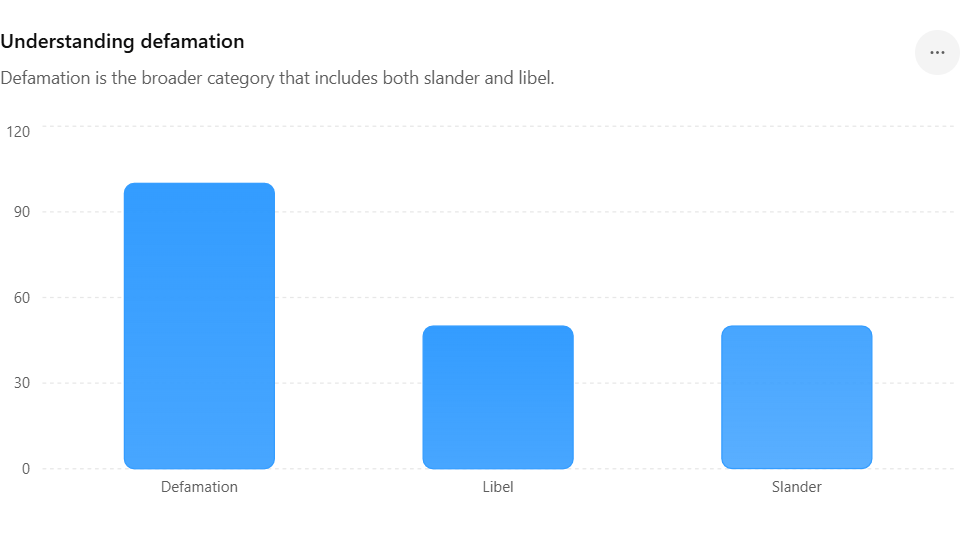
Defamation is the broader category that includes both slander and libel.
The chart isn’t showing legal percentages—it’s simply illustrating that libel and slander are subcategories within the broader concept of defamation.
What Is Defamation?
Defamation occurs when someone communicates a false statement presented as fact that harms another person’s reputation. The key elements generally include:
- A statement is made
- The statement is false
- It is communicated to another person
- Harm results
- Legal standards for fault are met
At its core, defamation law exists to protect one of the most valuable things a person possesses: Their reputation.
Because while money can be recovered and property can be rebuilt, trust is often far harder to restore.
What Is Slander?
Slander refers to defamatory statements that are spoken. These statements are usually verbal and temporary.
Examples include:
- False accusations during a meeting
- Harmful rumors spread verbally
- Untrue statements made in interviews
- False allegations during public speeches
Imagine a manager telling employees:
“John has been stealing company money.”
If the accusation is false and damages John’s reputation, the statement may constitute slander.
Why Slander Cases Can Be Difficult
The challenge with slander is evidence. Words disappear, conversations end, and memories fade. Unlike written publications, spoken statements often leave little proof behind.
This is one reason slander cases can be more difficult to prove than libel cases.
The question frequently becomes:
- Who said what?
- When?
- To whom?
- And can it be proven?
What Is Libel?
Libel refers to defamatory statements that are written, published, or otherwise permanently recorded.
Examples include:
- Newspaper articles
- Blog posts
- Social media posts
- Emails
- Online reviews
- Digital publications
If someone publishes:
“This accountant scams all of her clients.”
and the statement is false, that may be libel. Unlike slander, libel often leaves a trail.
- Screenshots.
- Articles.
- Comments.
- Messages.
Evidence tends to be easier to preserve.
Why Libel Has Become Increasingly Important
For most of human history, slander traveled faster than libel.
Today, the opposite is often true, the internet changed everything.
A false statement online can:
- Reach millions of people
- Remain searchable for years
- Spread internationally
- Be copied endlessly
One tweet. One Facebook post. One viral video. Sometimes that is all it takes.
Modern defamation disputes increasingly involve digital publications rather than private conversations.
The Three Questions Courts Often Ask
When evaluating potential defamation claims, courts often focus on three major questions.
Was the Statement Presented as Fact?
This is crucial. The law usually distinguishes between:
Opinion
“I think that restaurant has terrible service.”
Factual Claim
“That restaurant poisons its customers.”
Opinions are often protected. False factual accusations create greater legal risk.
Was the Statement False?
Truth is one of the strongest defenses in defamation law. This surprises many people.
People often ask:
“But what if the statement hurt my feelings?”
The law generally focuses less on emotional pain and more on factual accuracy. A statement can be damaging and embarrassing while still being legally protected if it is true.
Did Harm Occur?
Defamation law is often concerned with actual consequences.
Examples may include:
- Loss of employment
- Business losses
- Lost contracts
- Professional damage
- Social harm
- Reputational injury
The stronger the evidence of harm, the stronger the potential claim may become.
The Social Media Trap
One of the biggest legal risks today is that people publish first and verify later. Social media has created a culture where accusations spread instantly.
Many users mistakenly believe:
- Deleting a post eliminates liability
- Sharing someone else’s accusation creates no risk
- Private groups are legally protected spaces
None of those assumptions are necessarily true. A screenshot can survive long after deletion.
A forwarded rumor can create liability. A WhatsApp message can become courtroom evidence. The internet has transformed ordinary people into publishers; whether they realize it or not.
Common Examples of Defamation
Workplace Defamation
False accusations involving:
- Theft
- Harassment
- Fraud
- Misconduct
- Professional incompetence
can destroy careers before formal investigations even begin.
Business Defamation
Competitors sometimes spread false information regarding:
- Product quality
- Financial stability
- Regulatory compliance
- Customer treatment
The resulting losses can be substantial.
Online Defamation
This is now one of the fastest-growing areas of reputational harm.
Examples include:
- Viral misinformation
- Fake reviews
- False social media allegations
- Misleading blog content
The Mistake Most People Make
The biggest misconception is believing every insult equals defamation.
Not all offensive statements are defamatory.
For example:
“I don’t like her.”
Generally not defamation.
“She embezzled company funds.”
Potentially defamatory if false. The difference often lies in whether the statement can be objectively proven true or false. That distinction is where many lawsuits succeed or fail.
Why Reputation Is More Valuable Than Ever
Historically, reputations were local.
Today they are digital. A person may spend decades building:
- Professional credibility
- Business relationships
- Community trust
- Personal influence
Yet one false allegation can spread globally within hours. That reality has transformed defamation law from a niche legal issue into a modern necessity. Because in today’s economy, reputation itself has become an asset.
- Entrepreneurs depend on it.
- Professionals depend on it.
- Creators depend on it.
- Businesses depend on it.
And increasingly, ordinary individuals depend on it too.
Law Is Trying to Balance Two Powerful Rights
The challenge facing courts is difficult.
Societies generally value:
Freedom of Speech
People should be able to express opinions, criticize leaders, and discuss public issues.
Protection of Reputation
People should not be destroyed by false factual accusations. The law constantly attempts to balance these competing interests. Too much restriction harms free expression. Too little protection harms reputations.
The tension between these rights is why defamation law remains one of the most complex areas of modern legal practice.
The Bigger Lesson: Words Have Consequences
Many people think legal risk comes primarily from contracts, businesses, or financial transactions. But some of the most expensive lawsuits begin with words.
- A careless statement.
- reckless accusation.
- viral post.
- forwarded message.
- A moment of anger.
The law recognizes something society sometimes forgets: Words can cause real harm, and when they do, legal consequences may follow.
Understand the Difference Before It Matters
If you remember only one thing, remember this:
- Defamation is the broad legal category.
- Slander is spoken defamation.
- Libel is written or published defamation.
Understanding these distinctions is not just legal trivia. It is practical knowledge for navigating a world where information travels faster than ever before. Because in the digital age, a reputation can take years to build and seconds to damage.
And sometimes the most important legal protection begins with understanding the power of what is said—and what is published.