

Africa is asking for more than a seat at the table. It is asking for a greater role in shaping the rules of the global system.
There was something striking about the speeches coming out of Africa at this year’s United Nations General Assembly. Different countries. Different leaders. Different national interests.
But listen closely, and a common message begins to emerge. Africa is asking a deceptively simple question:
Who gets to make the decisions that shape our future?
That question goes far beyond the United Nations. It touches Africa’s security, natural resources, debt, access to finance, industrial ambitions, energy future and, ultimately, its place in the global economy.
In 2026, the conversation appears to be moving beyond Africa simply asking to be heard. Increasingly, African leaders are asking for something bigger: a more permanent role in the rooms where some of the world’s most consequential decisions are made.
And that is what makes the African conversation at the UN particularly important.
The first question: Who gets to decide?
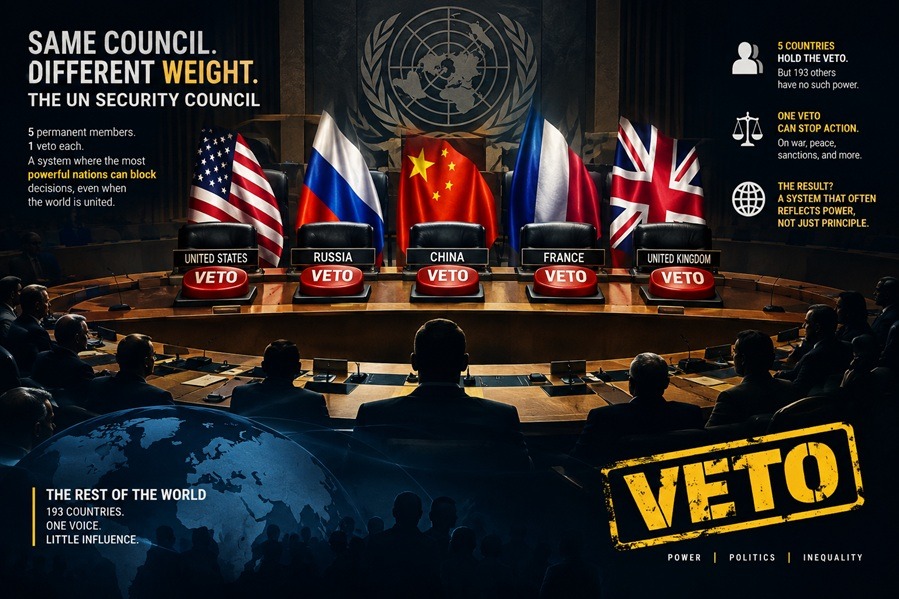
Consider the United Nations Security Council. The Council has 15 members. Five are permanent: China, France, Russia, the United Kingdom and the United States. The remaining 10 members are elected for two-year terms.
But there is a fundamental difference between the two groups. The five permanent members possess veto power. That means that, on substantive matters, one permanent member can block a resolution even when the other members support it.
For decades, African governments have pointed to this structure as one of the clearest examples of the continent’s limited representation in global decision-making. Africa has no permanent seat on the Security Council.
African countries can and do serve as elected members. But those positions are temporary, and they do not carry the veto power attached to permanent membership. This is why the call for Security Council reform continues to matter to African governments.
At this year’s General Assembly, Nigeria called for at least two permanent seats for Africa, with veto rights, alongside five non-permanent seats for the continent. Kenya and Ghana also raised the question of permanent African representation.
The argument is straightforward: the international system created after the Second World War was designed around a very different distribution of political power. When the United Nations was created in 1945, much of Africa was still under colonial rule.
Today, Africa comprises 54 sovereign states and represents one of the largest regional groupings in the United Nations. Yet it remains without permanent representation on the body responsible for some of the world’s most consequential questions of international peace and security.
That raises a broader question:
Can an institution created for the world of 1945 adequately represent the geopolitical realities of the 21st century?
But there is an even more important question. Suppose Africa gets those seats.
What changes?
A seat at the table is not the same as power
Representation matters. But representation alone does not equal power. A permanent seat may give African states a stronger institutional voice. But modern power is not exercised only through military strength or diplomatic positions.
It is also exercised through:
- Money.
- Technology.
- Markets.
- Energy.
- Food.
- Industrial capacity.
- Infrastructure.
- And increasingly, through control over the resources that will determine the next generation of global technologies.
This brings us to another major theme running through the African conversation: critical minerals.
Africa has the resources. But where is the value created?
Think about the technologies that increasingly define the modern economy.
- Your smartphone.
- An electric vehicle.
- A battery.
- Solar panels.
- Advanced industrial equipment.
Behind many of these technologies are minerals that have become strategically important to the global economy. Africa possesses significant mineral resources that the world needs.
But having a resource underground and controlling the economic value created from that resource are two very different things. And this is where the question becomes more uncomfortable.
What happens after the mineral leaves the ground?
If the mineral is extracted in Africa but processed somewhere else, refined somewhere else, transformed into components somewhere else and eventually incorporated into a finished product somewhere else, then much of the economic value may be created outside the continent.
- Africa has the resource.
- But someone else may control the processing.
- Someone else may control the technology.
- Someone else may manufacture the finished product.
- Someone else may capture much of the value.
That is why resource sovereignty and value addition have become increasingly important parts of the African economic conversation. The issue is not simply whether Africa should sell its natural resources.
Africa needs international investment. It needs capital. It needs technology. It needs access to global markets. The more important question is:
- What kind of partnership should Africa build with the rest of the world?
- Is Africa simply the place where raw materials come from?
- Or can it increasingly become a place where those materials are processed, refined and transformed into higher-value products?
- Can factories be built around those resources?
- Can African engineers and technical professionals participate in the industries that emerge?
- Can more of the final value be created on the continent?
That would represent a fundamentally different economic relationship.
The security question is connected too
At first glance, security appears to be a completely separate issue. But it is connected to the same question of power and capacity. Nigeria’s message at the UN linked terrorism and organised crime to a practical reality: criminal and extremist networks do not respect national borders in the same way governments do.
- Weapons cross borders.
- Money crosses borders.
- People cross borders.
- Information crosses borders.
So why should the response to these threats stop at the border?
Nigeria called for stronger intelligence sharing, disruption of terrorist financing and greater cooperation to prevent the movement of illegal weapons across borders.
But there was another important dimension to the argument.
Military action alone cannot solve every security problem.
If a young person has no access to education, no employment, no economic opportunity and lives in an environment where armed groups can recruit, military force may address the immediate threat without necessarily addressing the conditions that allow the threat to return.
That changes the question.
Instead of asking only:
How do we defeat the gunman?
We also have to ask:
Why is the gunman finding people to recruit?
That connects security to education, economic opportunity, governance and community protection. And suddenly, security is no longer just a military issue. It becomes an economic and developmental issue as well.
The money behind development
Then there is finance. African countries have repeatedly raised concerns about debt burdens, the cost of capital, access to development finance and the broader architecture of global finance.
These issues can sound abstract.
But they are not.
The cost of capital ultimately affects whether a country can build roads, railways, power systems, factories, schools and other infrastructure.
- It affects how governments finance development.
- It affects what businesses can afford to build.
- It affects how quickly economies can industrialise.
So when African leaders call for reforms to the global financial system, they are not simply talking about economists and financial institutions. They are talking about the cost of building the physical and economic foundations on which ordinary people depend.
And then there is climate finance.
Africa contributes relatively little to global emissions compared with major industrial economies, yet African countries face significant climate-related risks.
That creates another difficult question:
Who pays for adaptation?
- Who finances resilient infrastructure?
- Who helps African countries transition to cleaner energy?
- And perhaps most importantly: Who benefits economically from that transition?
Because Africa does not simply want to be told to transition.
- It also wants to know whether it can build industries around the transition.
- If the world needs batteries, can Africa process the minerals required to make them?
- If the world needs renewable energy, can African countries manufacture some of the equipment?
- If the world needs green technologies, can African engineers and companies participate in those supply chains?
That is the difference between being a supplier of raw materials and becoming a producer of value.
The deeper connection
At first glance, these issues seem disconnected.
- Security Council reform.
- Critical minerals.
- Terrorism.
- Debt.
- Climate finance.
- Industrialisation.
- Trade.
But they are actually connected by one larger question:
How much influence does Africa have over the systems that shape its future?
Consider the pattern.
- If Africa possesses natural resources but has limited control over processing and value chains, it has resources without capturing enough of their economic value.
- If Africa has a huge population but limited influence in major global institutions, it has scale without equivalent political representation.
- If African countries have national borders but insecurity constantly crosses those borders, sovereignty becomes harder to protect in practice.
- If countries borrow at high cost while trying to build infrastructure and industry, their development ambitions become constrained by the financial system around them.
These are not isolated problems. They are different expressions of the same structural challenge: having assets is not the same as having leverage.
But Africa must also ask itself a difficult question
There is an important part of this conversation that cannot simply be directed at the rest of the world.
Africa must also look inward.
It is easy to ask:
Why won’t the world give Africa more power? But there is another question that may be just as important: What is Africa doing with the power it already has?
- The continent has 54 countries.
- It has the African Union.
- It has regional economic communities.
- It has enormous natural resources.
- It has a rapidly growing population and one of the world’s youngest demographic profiles.
And collectively, African countries represent a substantial market. But size does not automatically become influence.
Influence requires coordination. If African countries negotiate separately, trade separately, borrow separately and compete against one another for investment, how much collective bargaining power is being left on the table?
This is where continental integration becomes more than a political slogan. The African Continental Free Trade Area represents one attempt to create a much larger integrated African market.
The underlying logic is simple.
A company serving a relatively small market has one level of bargaining power. A company capable of reaching hundreds of millions of consumers has another. The same principle can apply to governments.
Scale creates leverage. But only if that scale can be organised and translated into collective action.
What kind of Africa will sit at the table?
This may be the most important question emerging from the African speeches at the United Nations. The debate over permanent African representation on the Security Council will require negotiations among UN member states and, ultimately, changes to the UN Charter.
There is no automatic outcome simply because African leaders demand reform. But perhaps the deeper question is not only whether Africa eventually gets a permanent seat.
It is:
What kind of Africa will be sitting at that table if the system changes?
- An Africa that exports raw materials?
- Or an Africa that processes them?
- An Africa that imports most of the technology it needs?
- Or an Africa that increasingly builds it?
- An Africa that negotiates 54 separate national interests?
- Or an Africa capable of acting collectively where its interests overlap?
Because representation matters. But representation is only one component of power.
- Economic strength matters.
- Industrial capacity matters.
- Technology matters.
- Security matters.
- Strong institutions matter.
- And perhaps most importantly, the ability to act together matters.
The bigger picture
So when you listen to the speeches coming out of Africa at the United Nations, do not listen only for the individual demands.
Listen for what sits underneath them.
- Different issues.
- Different countries.
- Different priorities.
But one larger question: What role does Africa want to play in shaping the world that comes next?
Perhaps the African conversation is no longer simply about being included in the global system. Perhaps it is increasingly about having a greater role in shaping the system itself.
That is a much bigger conversation than Security Council reform.
It is a conversation:
- About resources.
- About industry.
- About finance.
- About security.
- About technology.
- About markets.
- About institutions.
- And ultimately, about power.
Because the real question is not simply whether Africa will have a seat at the table. It is whether Africa will have enough economic, political and institutional leverage to influence what happens at that table.
That is the bigger story.
And that may be the question worth watching long after the speeches at the General Assembly are over.
