

One Punch. Two Very Different Criminal Charges.
It started as an argument over a parking space. Two strangers exchanged heated words outside a shopping center. One man shoved the other, and the confrontation appeared to end.
Then, in a split second, one of them grabbed a metal wrench from the trunk of his car and swung it. The victim survived it, and the attacker was subsequently arrested.
Friends watching the news later asked the same question:
“Isn’t that just assault?”
Not exactly. Legally, that single decision, to introduce a weapon, may transform an ordinary assault into aggravated assault, a much more serious criminal offence with far heavier consequences.
Many people assume assault is assault.
The law often disagrees.
Understanding the difference could determine whether someone faces a relatively minor criminal charge—or years behind bars.
What Is Assault?
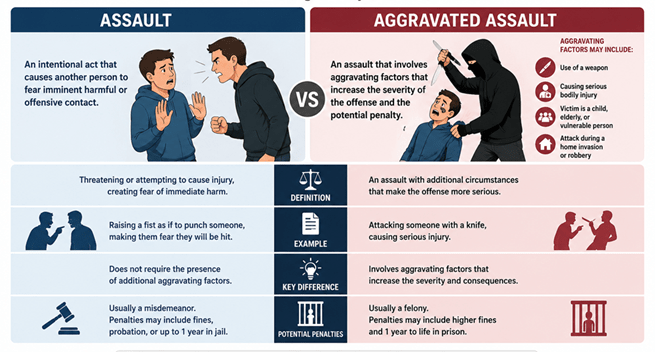
At its simplest, assault involves intentionally causing another person to fear immediate unlawful physical harm or, in many jurisdictions, intentionally causing unlawful physical contact.
Exactly how assault is defined varies from country to country and even between states or provinces.
Generally, assault involves conduct such as:
- Threatening someone with immediate violence
- Attempting to strike someone
- Physically attacking another person
- Intentionally causing unlawful physical injury
The important point is this:
Assault is about unlawful violence or the immediate threat of violence.
It does not have to involve severe injuries.
What Is Aggravated Assault?
Aggravated assault is a more serious form of assault involving circumstances that significantly increase the gravity of the offence.
These aggravating factors often include:
- Use of a deadly weapon
- Serious bodily injury
- Assault against vulnerable victims
- Assault against police officers or emergency personnel
- Intent to commit another serious crime
- Strangulation or life-threatening conduct
Think of aggravated assault as assault with circumstances that make the danger substantially greater.
The law recognizes that not every violent act carries the same level of risk.
The Difference in One Sentence
If assault is an unlawful attack or threat,
Aggravated assault is an assault made significantly more dangerous because of the injuries caused, the weapon used, the victim involved, or the circumstances surrounding the attack.
That distinction may dramatically affect criminal penalties.
Why the Law Treats Them Differently
Imagine two situations.
Scenario One
Two people argue.
One pushes the other.
The victim suffers minor bruising.
Scenario Two
Two people argue.
One attacks the other with a knife.
The victim requires emergency surgery.
Both incidents involve violence.
But society recognizes that the second incident creates far greater danger.
Criminal law reflects that difference.
Punishment generally increases as the level of danger increases.
Common Examples of Assault
Simple assault may include situations such as:
- Punching someone during an argument
- Slapping another person
- Throwing an object that narrowly misses someone
- Threatening immediate violence while attempting to strike
- Minor physical altercations
Not every case causes serious injury.
The unlawful conduct itself is often enough.
Common Examples of Aggravated Assault
Aggravated assault often involves circumstances like:
- Attacking someone with a firearm
- Using a knife during an assault
- Striking someone with a dangerous object
- Causing broken bones or permanent injuries
- Assaulting a child, elderly person, or vulnerable victim
- Intentionally causing life-threatening injuries
The greater the danger, the more likely prosecutors will pursue aggravated charges.
The Role of Weapons
One of the biggest differences between assault and aggravated assault is the use of a weapon.
Weapons may include:
- Guns
- Knives
- Machetes
- Metal pipes
- Baseball bats
- Broken bottles
- Vehicles used intentionally to strike someone
Interestingly, almost any ordinary object can become a dangerous weapon depending on how it is used.
A kitchen knife used to prepare dinner is harmless.
The same knife used during an attack becomes evidence in a serious criminal case.
Intent and circumstances matter enormously.
Does Serious Injury Always Have to Occur?
Not necessarily.
This surprises many people.
In many legal systems, aggravated assault may be charged even if the victim escapes serious injury.
For example:
Someone fires a gun intending to injure another person but misses.
The victim survives unharmed.
The conduct may still qualify as aggravated assault because of the extreme danger involved.
The law often evaluates both:
- What happened
- What could reasonably have happened
What Prosecutors Usually Try to Prove
Although legal standards vary across jurisdictions, prosecutors often attempt to establish:
- Intentional conduct
- Unlawful use of force
- Dangerous circumstances
- Serious bodily injury or weapon use
- Lack of lawful justification
Each element becomes important during criminal proceedings.
Missing one element may significantly affect the outcome of a case.
Possible Legal Defenses
Being charged does not automatically mean someone is guilty.
Depending on the facts and local law, possible defenses may include:
Self-Defense
A person may lawfully use reasonable force to protect themselves from an imminent unlawful attack.
However, the force used generally must be proportionate to the threat.
Defense of Another Person
Many legal systems allow reasonable force to protect someone else from immediate danger.
Lack of Intent
Some incidents involve genuine accidents rather than intentional violence.
Intent can become a major issue in criminal proceedings.
Mistaken Identity
Eyewitnesses are not always accurate.
Video evidence, forensic analysis, and witness testimony may become crucial when identity is disputed.
The Hidden Consequences Beyond Prison
Many people focus only on criminal penalties.
But assault convictions often affect far more than freedom.
A conviction may impact:
- Employment opportunities
- Professional licenses
- Immigration applications
- International travel
- Firearm ownership
- Child custody disputes
- Insurance costs
- Personal reputation
Sometimes the long-term consequences last far longer than the sentence itself.
The Social Media Problem
Today’s criminal investigations often begin online.
After a fight, people frequently upload:
- Videos
- Livestreams
- Photos
- Comments
- Voice notes
Ironically, individuals sometimes provide investigators with evidence against themselves.
A boastful social media post made minutes after an altercation may later appear in court.
In the digital age, criminal evidence is increasingly created by the people involved.
What Many People Get Wrong
One of the biggest misconceptions is believing that the victim decides whether charges proceed.
That is not always true.
Once police investigate and prosecutors determine sufficient evidence exists, criminal proceedings may continue even if the victim later changes their mind.
This is because crimes are generally considered offences against society—not merely against an individual.
That distinction surprises many people.
Violence Can Escalate Faster Than Anyone Expects
Most aggravated assault cases do not begin with an intention to commit a serious crime.
Many begin with:
- A heated argument
- Alcohol consumption
- Road rage
- Domestic conflict
- Sporting events
- Financial disputes
- Neighbour disagreements
One impulsive decision.
One object picked up in anger.
One blow delivered without thinking.
And suddenly, an ordinary disagreement becomes a life-changing criminal case.
That is why emotional control is often one of the strongest forms of legal protection.
The Bigger Lesson About Criminal Law
Criminal law is not simply about punishment.
It is about protecting public safety.
The distinction between assault and aggravated assault reflects an important principle:
The law recognizes degrees of harm.
Not every unlawful act creates the same level of danger.
Accordingly, not every offence receives the same punishment.
This graduated approach allows courts to distinguish between impulsive misconduct and conduct that presents extraordinary risks to human life.
Final Thoughts: Small Decisions Can Carry Enormous Legal Consequences
When people hear the word “assault,” they often imagine a single criminal offence.
In reality, criminal law recognizes many levels of seriousness.
The difference between assault and aggravated assault may depend on:
- The weapon used
- The injuries caused
- The victim involved
- The offender’s intent
- The surrounding circumstances
Understanding that difference is not merely useful legal knowledge. It is a reminder that moments of anger can produce consequences that last a lifetime.
Because while an argument may last only minutes, a criminal record can follow someone for decades.
