

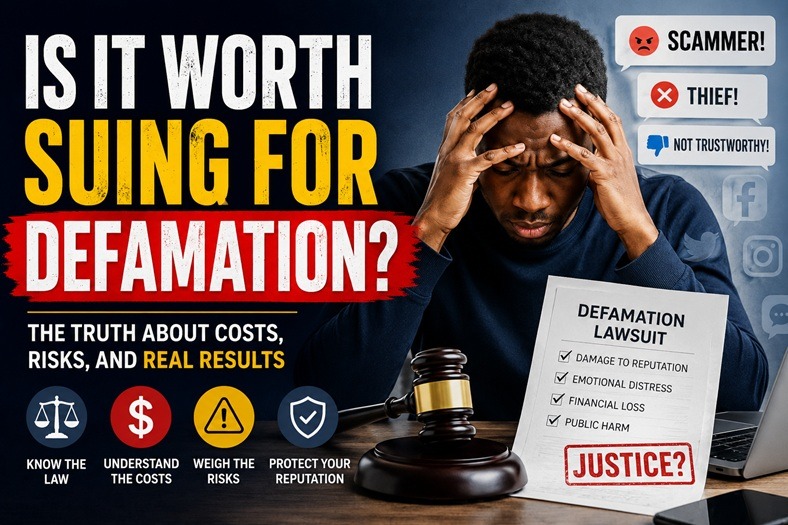
One Post. One Rumor. One Sentence That Changed Everything.
Ada noticed something was wrong before anyone said it directly. Her phone had become strangely quiet; Clients stopped responding, a business partnership suddenly collapsed, and friends began acting distant.
Then someone finally sent her a screenshot; a former associate had posted online accusing her of fraud.
No evidence.
No court judgment.
Just a confident accusation shared publicly like fact.
Within days:
- Her reputation began collapsing
- Customers disappeared
- People whispered
- Opportunities vanished
The worst part is that the post spread faster than the truth ever could. That was the moment Ada asked the question thousands of people silently ask every year:
“Should I sue for defamation?”
But behind that question hides a deeper one people rarely discuss honestly:
“Is it actually worth it?”
Because defamation lawsuits are emotionally satisfying in theory…, but legally, financially, and psychologically complicated in reality.
What Is Defamation?
Defamation happens when someone makes a false statement presented as fact that harms another person’s reputation. Defamation generally falls into two categories:
Libel
Written or published defamatory statements.
Examples:
- Social media posts
- Blog articles
- News publications
- Emails
- Online reviews
Slander
Spoken defamatory statements.
Examples:
- Public accusations
- Verbal rumors
- False workplace allegations
- Statements made during interviews or meetings
At its core, defamation law attempts to balance two important rights:
- Freedom of expression
- Protection of reputation
And that balance is where things become legally difficult.
Why Defamation Cases Feel So Personal
Most legal disputes are about money, contracts, or property. Defamation feels different, because reputation is emotional.
A defamatory statement can damage:
- Careers
- Relationships
- Business opportunities
- Mental health
- Social standing
- Public trust
And unlike physical damage, reputation damage is often invisible. People may never tell you why they stopped trusting you. They simply disappear.
That emotional pain is why many people immediately want to sue. But emotion alone is not enough to win a defamation case.
The First Reality Check: Defamation Is Harder to Prove Than Most People Think
This shocks many people. They assume:
“Someone lied about me publicly, so I automatically have a strong case.”
Not necessarily.
In many legal systems, proving defamation requires multiple elements.
Typically, you must show:
- A false statement was made
- The statement was presented as fact
- The statement was communicated to others
- Harm occurred
- The defendant acted negligently or maliciously
And each of those elements can become a legal battlefield.
Opinion vs Defamation: The Line Most People Misunderstand
One of the biggest misconceptions is believing every insulting statement is defamatory.
The law usually distinguishes between:
- Statements of fact
- Statements of opinion
For example:
“I think this manager is incompetent.”
That may be rude, but often protected as opinion.
Now compare it to:
“This manager stole company money.”
That is a factual accusation capable of being proven true or false.
And factual accusations create far greater legal risk.
This distinction becomes extremely important online, where people casually post emotionally charged statements without understanding legal consequences.
The Internet Changed Everything
Before social media, harmful rumors spread slowly. Now they spread globally in minutes.
A single tweet, TikTok video, WhatsApp broadcast, Facebook post, or YouTube clip can:
- Destroy a business
- Trigger public outrage
- Cause job loss
- Create permanent digital damage
Even deleted posts may survive through screenshots. And unfortunately, online audiences often assume accusation equals truth.
That is one reason defamation claims have become increasingly common worldwide. But increased visibility has not made lawsuits easier. In many ways, it has made them more complicated.
So… Is It Actually Worth Suing for Defamation?
The honest answer is:
Sometimes yes. Sometimes absolutely not.
And that depends on several critical factors.
When Suing for Defamation May Be Worth It
1. The Damage Is Severe and Measurable
A stronger case often involves clear, provable harm.
For example:
- Loss of employment
- Loss of clients
- Financial losses
- Contract cancellations
- Business decline
- Public humiliation with evidence
Courts generally take measurable harm more seriously than vague emotional frustration.
2. The Statement Is Clearly False
Truth is one of the strongest defenses against defamation claims. If the statement is substantially true, even if embarrassing, the case may collapse quickly.
This is why many people lose defamation lawsuits: they focus on emotional pain instead of factual accuracy.
3. There Is Strong Evidence
- Screenshots.
- Emails.
- Recorded statements.
- Witnesses.
- Analytics.
- Contracts.
- Financial records.
Defamation cases often become evidence wars. Without evidence, emotional certainty means very little legally.
4. The Defendant Has Reach or Influence
A false accusation from:
- A media outlet
- An influencer
- A public figure
- A company executive
- A major platform
can create large-scale damage quickly. The wider the publication, the greater the potential impact.
When Suing for Defamation May NOT Be Worth It
This is the part most lawyers discuss privately.
Lawsuits Are Expensive
Defamation litigation can become extremely costly.
You may spend:
- Legal fees
- Court costs
- Investigation expenses
- Expert witness fees
- Time away from work
And cases may drag on for years. Some people spend enormous amounts chasing emotional closure they never fully receive.
You May Draw More Attention to the Defamation
This is called the “Streisand Effect.”
Sometimes suing causes more people to discover the original accusation. A rumor seen by 500 people may suddenly reach millions because the lawsuit created publicity. Ironically, legal action can unintentionally amplify reputational damage.
Winning Does Not Always Repair Reputation
This is a painful reality. Even successful plaintiffs sometimes discover:
- Public perception remains damaged
- Online content continues spreading
- Search engine results persist
- Suspicion never fully disappears
The law can award money; It cannot always restore trust.
The Emotional Toll Is Heavy
Defamation lawsuits are deeply personal.
During litigation:
- Private details may become public
- Communications may be examined
- Personal history may be scrutinized
- Opposing lawyers may aggressively challenge credibility
Many people underestimate the emotional exhaustion involved.
Public Figures Face an Even Higher Standard
If the person suing is a public figure, celebrity, politician, or prominent public personality, the legal threshold may become even harder.
In some jurisdictions, public figures must prove “actual malice.” That means showing the defendant either:
- Knew the statement was false
- Or acted with reckless disregard for the truth
This higher standard exists because democratic societies often prioritize open debate about public figures. But it also makes lawsuits significantly more difficult.
Workplace Defamation: The Silent Career Killer
One of the least discussed forms of defamation happens quietly inside workplaces.
False allegations about:
- Theft
- Harassment
- Fraud
- Misconduct
- Professional incompetence
can destroy careers internally before courts ever become involved. And workplace defamation is especially dangerous because rumors inside organizations spread rapidly through informal conversations.
Sometimes people are effectively punished socially before any investigation concludes. That reality makes documentation extremely important.
What You Should Do Before Filing a Defamation Lawsuit
1. Preserve Evidence Immediately
Take screenshots.
Save emails.
Record dates.
Preserve URLs.
Archive messages.
Digital evidence disappears quickly.
2. Avoid Emotional Retaliation
Many people worsen their situation by responding publicly in anger. Aggressive online retaliation may:
- Damage credibility
- Create counterclaims
- Escalate conflict unnecessarily
Strategic silence is sometimes more powerful than emotional reaction.
3. Consult a Qualified Lawyer Early
Defamation law varies heavily by jurisdiction. A legal professional can help evaluate:
- Strength of the case
- Likelihood of success
- Financial practicality
- Alternative solutions
Sometimes a legal letter alone resolves the issue without full litigation.
4. Consider Non-Litigation Solutions
Not every reputational dispute needs a courtroom.
Possible alternatives include:
- Retractions
- Corrections
- Mediation
- Settlement agreements
- Platform takedown requests
- Reputation management strategies
Sometimes protecting your future matters more than winning a legal war.
The Mistake Many People Make
The biggest mistake is confusing: “Being hurt” with “Having a legally strong case”
Those are not always the same thing. The law operates on evidence, standards, and legal thresholds, not emotional certainty.
That can feel frustrating; Sometimes even unfair. But understanding that distinction is critical.
The Bigger Lesson About Reputation
Defamation law reveals something profound about modern society: Reputation has become both fragile and digital. A person can spend 20 years building trust…and 20 seconds watching it collapse online.
That reality affects:
- Entrepreneurs
- Professionals
- Creators
- Employees
- Public figures
- Ordinary individuals
The internet has made speech more powerful than ever before. But many people still speak as if words carry no legal consequences.
They do.
And increasingly, courts around the world are being forced to confront that reality.
Law Cannot Fully Heal Reputation
This may be the hardest truth of all. People often approach defamation lawsuits hoping for emotional restoration. But courts are limited.
They can:
- Award damages
- Order corrections
- Recognize wrongdoing
Yet they cannot fully erase public memory, online circulation, or emotional scars. That does not mean lawsuits are pointless. It simply means expectations must remain realistic.
- Sometimes the goal is justice.
- Sometimes deterrence.
- Sometimes financial recovery.
- Sometimes public accountability.
But rarely is it complete emotional closure.
Final Thoughts: Sometimes the Smartest Legal Move Is Strategic, Not Emotional
Defamation is serious.
False accusations can destroy lives, businesses, and mental peace.
But deciding whether to sue requires more than anger.
It requires:
- Strategy
- Evidence
- Financial realism
- Emotional endurance
- Legal clarity
Because in many cases, the real question is not:
“Was I wronged?”
The real question is:
“What outcome am I truly seeking?”
And sometimes, the most powerful response is not immediate retaliation. It is informed, calculated action.
Join the Statute Hub Community
At Statute Hub, we break down complex legal realities into clear, practical insights that help everyday people navigate modern life with confidence. From workplace disputes and reputation damage to contracts, business law, and digital rights, our mission is simple:
To make the law understandable, useful, and empowering.
Explore more articles, stay informed, and join a growing community that believes legal awareness is one of the strongest forms of protection in today’s world.