

“I Didn’t Even Know I Was in Trouble” James had worked at the company for four years. He arrived early. Stayed late. Helped train new staff. In his mind, he was a loyal employee doing his best in a difficult economy.
Then one Friday afternoon, his manager called him into a meeting. The room felt strangely formal. An HR officer sat quietly beside the manager holding a file.
Within ten minutes, James was informed that his “continued performance issues” had led to termination.
He was shocked. “What performance issues?” he asked. The manager began listing concerns:
- Missed deadlines.
- Poor communication.
- Repeated lateness.
- Failure to follow reporting procedures.
James stared in disbelief. No one had ever clearly explained that his job was at risk;
- No structured warning.
- No formal coaching.
- No documented improvement plan.
Just silence… until dismissal.
What happened to James is more common than most people realize, and it exposes one of the most misunderstood concepts in workplace law and HR management: Progressive discipline.
What Is Progressive Discipline?
Progressive discipline is a structured workplace process employers use to address employee misconduct, poor performance, or policy violations gradually rather than immediately resorting to termination.
In simple terms, it is meant to give employees:
- Fair warning
- An opportunity to improve
- Clear expectations
- A chance to correct mistakes before severe punishment occurs
The idea behind progressive discipline is simple: People should usually be given the opportunity to improve before losing their livelihood.
Instead of jumping straight to dismissal, employers typically increase disciplinary measures step by step.
Why Progressive Discipline Exists
Most workplace problems do not begin as disasters.
They usually begin as small patterns:
- Consistent lateness
- Poor communication
- Missed deadlines
- Failure to follow procedures
- Inappropriate workplace behavior
- Attendance issues
- Minor misconduct
Without structure, managers often react emotionally instead of professionally.
- One supervisor ignores the issue.
- Another overreacts.
- Another fires someone suddenly.
Progressive discipline was designed to create consistency, fairness, and documentation.
It protects both:
- The employee
- The employer
And in many cases, it reduces workplace conflict before legal disputes emerge.
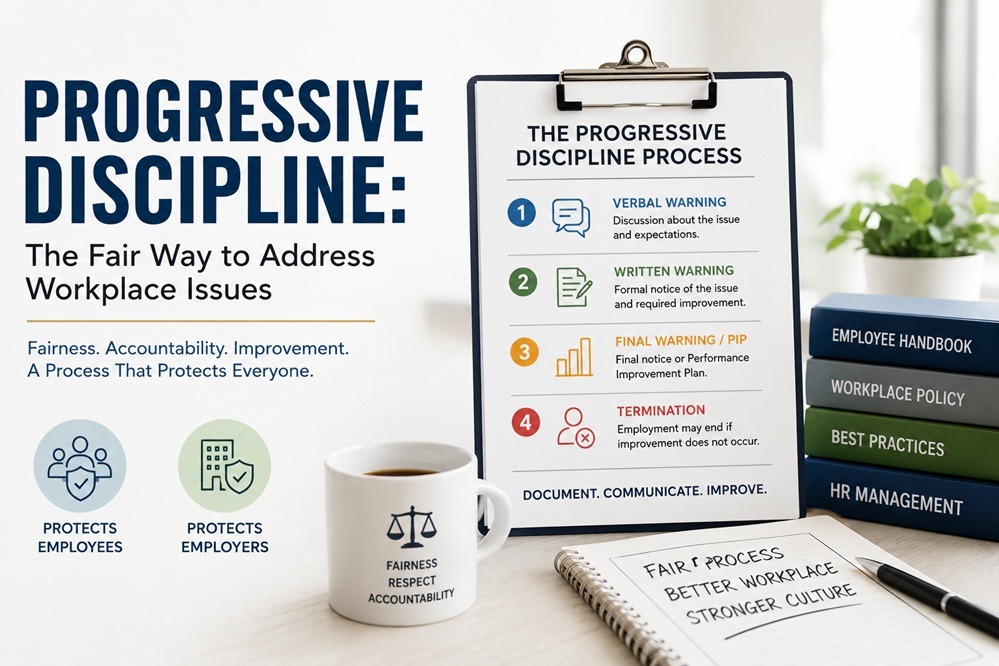
The Typical Stages of Progressive Discipline
Not every organization uses the exact same process, but most progressive discipline systems follow a similar structure.
1. Verbal Warning
This is often the first stage. A manager privately addresses the issue with the employee.
The goal is correction, not humiliation.
For example:
“We’ve noticed repeated lateness over the past month. We need improvement moving forward.”
A good verbal warning should:
- Be respectful
- Be specific
- Explain expectations clearly
- Document the conversation internally
Many managers fail at this stage because they become vague, emotional, or passive-aggressive, and employees cannot fix problems they do not fully understand.
2. Written Warning
If the behavior continues, the issue may escalate into a formal written warning.
This document usually outlines:
- The problem
- Previous discussions
- Expected improvements
- Possible consequences if behavior continues
This stage becomes legally important because documentation matters heavily in employment disputes. A written warning creates a record, and records often become evidence.
3. Final Warning or Performance Improvement Plan (PIP)
At this point, the employer is signaling serious concern.
The employee may receive:
- A final written warning
- A suspension
- A structured improvement plan
A Performance Improvement Plan often includes:
- Specific goals
- Deadlines
- Performance measurements
- Monitoring periods
This stage is meant to provide one final opportunity for correction.
But in reality, many employees begin panicking here because they realize the situation has become serious.
4. Termination
If improvement does not occur, employment may end.
At this stage, the employer usually relies heavily on earlier disciplinary documentation to justify the decision. This becomes especially important in jurisdictions where wrongful termination claims are common.
The Biggest Myth About Progressive Discipline
Many employees believe progressive discipline is legally required in every workplace, but that is not always true. This is where things become complicated.
In some countries or employment systems:
- Employers are expected to follow fair disciplinary procedures
- Labor laws require due process
- Collective bargaining agreements impose disciplinary steps
But in other environments, especially “at-will employment” systems, employers may legally terminate employees without following every progressive discipline stage.
That shocks many workers. People often assume fairness automatically equals legality.
Unfortunately, workplace law does not always operate emotionally.
This is why understanding your:
- Employment contract
- Staff handbook
- Local labor laws
- Union agreements
is extremely important.
Why Employers Use Progressive Discipline
1. Legal Protection
One major reason employers use progressive discipline is risk management. If an employee files a claim for:
- Wrongful termination
- Discrimination
- Unfair dismissal
- Retaliation
the employer may rely on disciplinary records as evidence. Documentation can become the difference between winning and losing a legal dispute.
2. Workplace Fairness
Good organizations understand something important: People make mistakes.
A structured disciplinary process creates opportunities for learning instead of immediate punishment. That can improve morale, retention, and workplace trust.
3. Consistency
Without structured discipline, workplace culture becomes dangerous.
Employees begin asking:
- “Why was I punished but others were not?”
- “Why does management treat people differently?”
- “Why are rules selective?”
Consistency protects organizational credibility.
The Hidden Problems With Progressive Discipline
Although progressive discipline sounds fair in theory, reality is often more complicated.
Some Managers Weaponize It
In toxic workplaces, disciplinary processes become tools for intimidation.
Managers may:
- Create unnecessary write-ups
- Target disliked employees
- Build documentation to justify predetermined termination
- Use vague accusations strategically
Sometimes the process is less about correction and more about creating a paper trail. That is the uncomfortable truth many employees eventually discover.
Employees Sometimes Ignore Early Warnings
Another major problem is denial. Some employees dismiss verbal warnings casually:
- “It’s not serious.”
- “My manager is just stressed.”
- “Everyone does this.”
Then months later, they are shocked when termination occurs.
Small workplace issues become dangerous when ignored repeatedly.
Poor Documentation Creates Chaos
A manager may verbally warn an employee but fail to document it properly.
Later, HR records appear incomplete. This creates confusion, inconsistency, and legal vulnerability.
Good discipline systems rely on clear documentation, not memory.
What Employees Should Do Immediately After Receiving a Warning
Most people react emotionally after receiving workplace discipline.
That reaction is understandable, but emotional reactions can make situations worse.
Instead:
Stay Calm
Do not become defensive immediately. Even if the warning feels unfair, reacting aggressively may strengthen the employer’s concerns.
Ask Questions
Clarify:
- What specific issue exists?
- What improvement is expected?
- What timeline applies?
- What support is available?
Vague criticism is dangerous. Clarity matters.
Keep Records
Document:
- Meetings
- Emails
- Instructions
- Performance discussions
This is especially important if you believe:
- You are being targeted unfairly
- Policies are inconsistently applied
- Discrimination may exist
Professional documentation protects everyone.
Improve Immediately
Many employees waste valuable time debating fairness instead of correcting the issue. Even when discipline feels harsh, improvement still matters strategically.
What Employers Often Get Wrong
Many organizations think progressive discipline is simply about punishment.
That mindset destroys workplace culture. The best disciplinary systems are actually communication systems.
Good employers:
- Explain expectations clearly
- Coach before escalating
- Document fairly
- Apply rules consistently
- Separate emotion from policy
Employees are far more likely to improve when discipline feels structured instead of personal.
The Deeper Truth About Workplace Discipline
Progressive discipline reflects a deeper reality about modern work: Employment is no longer based only on effort. It is increasingly based on:
- Communication
- Documentation
- Accountability
- Professional behavior
- Policy compliance
Many hardworking employees struggle not because they lack skill, but because they underestimate organizational systems.
Meanwhile, many employers create legal exposure because they fail to manage people properly.
The modern workplace is not just emotional; It is procedural. And procedure matters more than many people realize.
Law Is Quiet Until It Isn’t
One of the most dangerous assumptions employees and employers make is believing workplace law only matters during lawsuits.
In reality, legal risk builds silently. It grows through:
- Poor communication
- Missing documentation
- Inconsistent enforcement
- Emotional management
- Ignored warnings
By the time conflict explodes, the damage often started months earlier.
Progressive discipline is not merely an HR process, it is an attempt to prevent workplace chaos before it becomes irreversible.
Final Thoughts: Discipline Should Create Clarity, Not Fear
At its best, progressive discipline protects dignity.
It gives people:
- Notice
- Structure
- Opportunity
- Accountability
But when abused, it becomes a weapon that destroys trust and morale.
That is why awareness matters. Employees should understand their rights and responsibilities. Employers should understand that leadership requires fairness, consistency, and emotional intelligence, not intimidation.
Because sometimes, the difference between a corrected mistake and a destroyed career is not talent. It is communication.
