
A young doctor in Lagos had finally achieved what many only dream about. After years of exhausting medical school lectures, sleepless nights during residency, and countless sacrifices, she opened her private medical practice. Her office was small but elegant, patients trusted her, and business was growing.
Then one afternoon, a legal notice arrived. A former patient had filed a lawsuit.
Suddenly, the excitement of building a professional career turned into fear. Not just fear of the lawsuit itself, but fear of losing everything she had worked for; Her savings, office equipment, and personal assets.
That was the moment she realized something most professionals discover far too late: being highly educated in your profession does not automatically mean you are legally protected in business.
Somewhere between building a career and building a practice, many professionals overlook one critical question: What business structure actually protects me?
And that is where the concept of a PLLC enters the conversation.
What Is a PLLC?
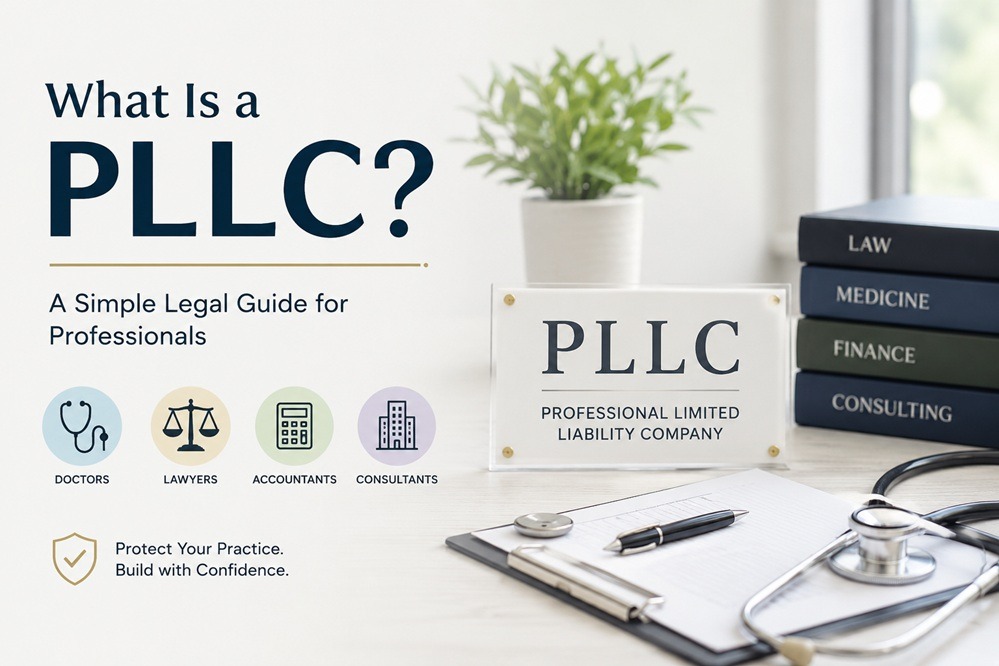
A PLLC, or Professional Limited Liability Company, is a special type of business structure designed specifically for licensed professionals. It functions similarly to a regular LLC (Limited Liability Company), but it is created for people whose work requires professional licensing or certification.
This often includes:
- Doctors
- Lawyers
- Architects
- Dentists
- Accountants
- Therapists
- Engineers
- Consultants in regulated professions
In simple terms, a PLLC allows professionals to operate their practice as a business while still receiving certain legal protections.
Think of it this way: A normal LLC is built for general businesses. A PLLC is built for licensed professionals whose work directly affects people’s lives, finances, health, or safety.
Why Does a PLLC Even Exist?
This is the part many people misunderstand. Governments and regulatory bodies treat professionals differently because professionals carry a higher level of responsibility.
If a restaurant makes a bad meal, customers may leave angry. But if a surgeon makes a critical mistake, the consequences can be life-changing.
Because of this, many jurisdictions require licensed professionals to form PLLCs instead of ordinary LLCs. The goal is balance.
The law wants professionals to enjoy business flexibility and some liability protection, but it also wants to ensure professionals remain personally accountable for professional negligence or malpractice.
That distinction is extremely important.
The Biggest Misunderstanding About PLLCs
Many people assume a PLLC completely shields them from lawsuits. That is not entirely true.
A PLLC can protect your personal assets from certain business debts and liabilities, but it usually does not protect you from your own professional malpractice.
For example:
- If your clinic cannot pay a supplier, a PLLC may help protect your personal property.
- But if you personally commit medical negligence, you can still be sued individually.
This is one of the most misunderstood parts of professional business law. The PLLC protects the business structure. It does not erase professional responsibility, and honestly, that makes sense.
Imagine if a lawyer could completely escape responsibility for serious legal misconduct simply because they formed a company. The legal system would collapse under abuse. So the law creates a middle ground.
PLLC vs LLC: What’s the Difference?
A Regular LLC
A traditional LLC is commonly used for:
- E-commerce businesses
- Restaurants
- Marketing agencies
- Retail stores
- Freelancers
- Startups
Its main appeal is liability protection and flexible taxation.
A PLLC
A PLLC is specifically reserved for licensed professions. In many regions, only licensed individuals can own or manage the PLLC.
For example:
A medical PLLC may require all owners to be licensed doctors.
A legal PLLC may require all members to be licensed attorneys.
This ensures professional standards remain regulated.
Why Professionals Often Choose a PLLC
1. Liability Protection
One of the biggest reasons professionals form PLLCs is to separate personal assets from certain business obligations. Without a legal business structure, personal savings, vehicles, or property may become vulnerable to business-related debts.
A PLLC creates a legal separation between the individual and the business entity.
2. Professional Credibility
There is psychological power in structure. Clients and patients often perceive incorporated professional practices as more established and trustworthy.
“ABC Dental PLLC” sounds more credible than simply operating informally under a personal name. In competitive industries, credibility matters.
3. Easier Business Operations
A PLLC can make it easier to:
- Open business bank accounts
- Sign contracts
- Hire employees
- Manage taxes
- Build partnerships
- Secure financing
In many ways, it transforms a professional practice into a scalable business.
4. Continuity and Growth
A PLLC can also help with long-term planning. If structured properly, it may support:
- Expansion
- Succession planning
- Bringing in partners
- Operational stability
This becomes especially important for professionals building practices designed to outlive them.
Who Usually Needs a PLLC?
The answer depends on local law. In the United States, some states require licensed professionals to form PLLCs instead of standard LLCs. Other jurisdictions may allow professionals to use regular LLCs.
In countries across Africa, professional regulation varies significantly depending on the profession and the country’s corporate laws.
For example:
- Medical councils
- Bar associations
- Engineering regulatory bodies
- Accounting institutes
may impose their own rules on business ownership and professional incorporation. That is why legal advice matters.
A structure that works perfectly in Texas may not work the same way in Nigeria, Kenya, South Africa, or the UK. This is where many internet articles fail readers; they oversimplify legal structures without considering jurisdictional differences.
How Do You Form a PLLC?
While procedures differ by country or state, the process generally involves several steps.
Step 1: Verify Professional Licensing
You typically must prove you hold a valid professional license. Some authorities may also require all business partners to hold licenses in the same field.
Step 2: Choose a Business Name
Many jurisdictions require the name to include “PLLC” or “Professional Limited Liability Company.” This signals to the public that the business is professionally regulated.
Step 3: File Formation Documents
You usually submit organizational documents to a government authority or corporate affairs agency.
This often includes:
- Business details
- Ownership structure
- Professional licensing information
Step 4: Obtain Regulatory Approval
Certain professions require approval from regulatory boards before the PLLC becomes active.
For example:
- Medical boards
- Legal associations
- Dental councils
may need to review the application.
Step 5: Create an Operating Agreement
This document explains:
- Ownership rights
- Profit sharing
- Decision-making processes
- Exit procedures
- Internal responsibilities
Many professionals skip this step until disputes arise. That is a costly mistake.
The Hidden Risks Most Professionals Ignore
Mixing Personal and Business Finances
One of the fastest ways to weaken liability protection is failing to separate personal and business activities. Using business accounts for personal spending creates legal confusion.
Courts may sometimes “pierce the corporate veil” if the business is not treated as a genuine separate entity.
Assuming Insurance Is Optional
A PLLC is not a replacement for professional liability insurance. This is critical. Doctors still need malpractice insurance. Lawyers still need professional indemnity coverage. Consultants still need risk protection.
The smartest professionals combine:
- Proper business structure
- Strong contracts
- Insurance coverage
- Compliance systems
Legal protection works best as layers, not shortcuts.
Choosing the Wrong Partners
In some PLLCs, one partner’s misconduct can still create operational chaos for the entire practice.
A bad partner can damage:
- Reputation
- Licensing relationships
- Client trust
- Financial stability
Many professionals spend years studying their craft but very little time studying partnership risk. That imbalance can become expensive.
The Bigger Lesson Behind PLLCs
The deeper issue here is not just business formation.
It is awareness.
Many professionals are trained to master technical skill, but not legal structure. Schools teach surgery, law, accounting, architecture, and engineering, but very few teach professionals how to legally protect the careers they spent decades building.
That gap creates vulnerability. The modern professional is no longer just a worker.
They are also:
- A brand
- A business owner
- A risk manager
- A decision-maker
And in today’s world, understanding legal structure is part of professional survival.
Law Is Not Just About Courtrooms
One of the most empowering realizations any professional can have is this:
- Law is not only about lawsuits.
- Law is also about prevention.
- It is about building systems that reduce chaos before problems appear.
- A PLLC is one example of that philosophy.
- It is not merely paperwork.
- It is part of a larger strategy of protecting income, reputation, relationships, and long-term stability.
- The professionals who thrive long term are often not just the most talented, they are the most structurally prepared.
The Cost of Ignoring Structure
Too many professionals focus entirely on making money without thinking about legal foundations, but success built on weak structure can become fragile very quickly.
A single lawsuit, dispute, debt issue, or regulatory problem can expose weaknesses that were invisible during growth.
Understanding what a PLLC is may seem like a small legal topic, but for many professionals, it becomes the difference between operating casually and building intelligently. And sometimes, the smartest legal decision is not made during a crisis, it is made before the crisis ever arrives.
Join the Statute Hub Community
The law affects more of your life than you may realize; from business and employment to contracts, property, digital rights, and personal protection.
At Statute Hub, we break down complex legal issues into practical, human-centered insights you can actually use.
Explore more articles, stay legally informed, and become part of a growing community that believes knowledge is one of the strongest forms of protection.